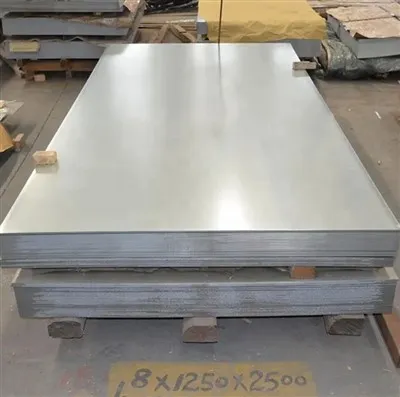
As a supplier of Z section steel, I often receive inquiries from customers about how to calculate the weight of Z section steel. This knowledge is crucial for construction projects, as it helps in estimating costs, determining load - bearing capacities, and planning transportation. In this blog, I'll walk you through the process of calculating the weight of Z section steel step by step.
Understanding Z Section Steel
Z section steel is a common structural shape used in construction, especially in roofing and wall systems. It is characterized by its Z - shaped cross - section, which provides excellent strength and stability. Compared to other sections like C - sections, Z - sections can be overlapped, making them ideal for continuous spans. You can find more details about Steel Z Purlins on our website.
The Basic Formula for Calculating Weight
The weight of any steel section can be calculated using the formula:
[ W = V\times\rho ]
Where:
- (W) is the weight of the steel section (in kilograms, kg).
- (V) is the volume of the steel section (in cubic meters, (m^{3})).
- (\rho) is the density of steel. The standard density of steel is approximately (7850 kg/m^{3}).
To calculate the volume (V) of Z section steel, we need to know its cross - sectional area (A) and its length (L). The volume formula is (V = A\times L). So, the weight formula can be rewritten as (W=A\times L\times\rho).
Measuring the Cross - Sectional Area of Z Section Steel
The cross - sectional area of Z section steel is a bit more complex to calculate compared to simple rectangular or circular shapes because of its irregular Z - shape. However, we can break it down into smaller, more manageable geometric shapes.
A typical Z section steel can be divided into rectangles. Let's assume the Z section has the following dimensions:
- The web height (h), the flange width (b), and the thickness of the web and flanges (t).
We can calculate the cross - sectional area (A) by adding up the areas of the individual rectangles. The Z section can be thought of as composed of three rectangles.
- The area of the web rectangle: (A_{1}=h\times t)
- The area of the top flange rectangle: (A_{2}=b\times t)
- The area of the bottom flange rectangle: (A_{3}=b\times t)
The total cross - sectional area (A = A_{1}+A_{2}+A_{3}=h\times t + 2\times b\times t=t\times(h + 2b))
For example, if the web height (h = 200mm=0.2m), the flange width (b = 80mm = 0.08m), and the thickness (t=3mm = 0.003m), then the cross - sectional area (A=0.003\times(0.2 + 2\times0.08)=0.003\times(0.2 + 0.16)=0.003\times0.36 = 0.00108m^{2})

Calculating the Weight
Once we have the cross - sectional area (A), we can calculate the weight of the Z section steel. Suppose the length of the Z section steel (L = 6m).
Using the formula (W = A\times L\times\rho), and substituting (A = 0.00108m^{2}), (L = 6m), and (\rho=7850kg/m^{3})
[W=0.00108\times6\times7850]
[W = 0.00648\times7850]
[W=50.868kg]
Using Tables for Quick Calculation
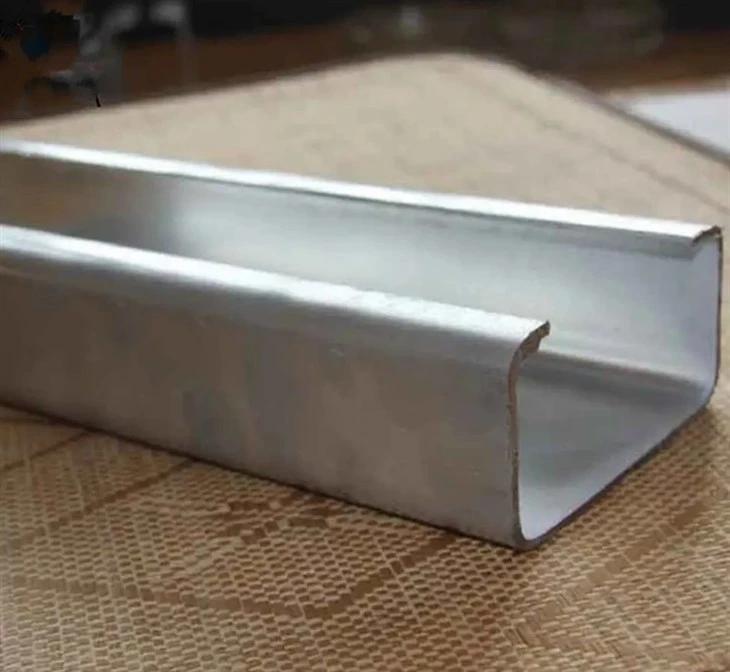
In real - world applications, calculating the cross - sectional area every time can be time - consuming. That's why we often use pre - calculated tables. These tables list the cross - sectional areas, unit weights (weight per unit length), and other properties of different sizes of Z section steel.
For example, if you are looking for Galvanised C Section Channel or 100Mm C Purlins, our website provides detailed specifications and weight tables to help you quickly determine the weight and other parameters you need.
Factors Affecting the Weight Calculation
- Thickness Variations: In practice, the actual thickness of Z section steel may deviate slightly from the nominal thickness due to manufacturing tolerances. This can cause small differences in the calculated weight.
- Surface Treatments: If the Z section steel has a coating such as galvanization, the weight of the coating should also be considered. Galvanized steel has a slightly higher weight compared to non - galvanized steel because of the zinc coating.
- Cutting and Welding: Any cutting or welding operations on the Z section steel can remove or add a small amount of material, which may affect the final weight.
Importance of Accurate Weight Calculation
Accurate weight calculation of Z section steel is essential for several reasons:
- Cost Estimation: Knowing the weight helps in accurately estimating the material cost. Steel is usually sold by weight, so an incorrect weight calculation can lead to over - or under - budgeting.
- Structural Design: The weight of the Z section steel is a crucial factor in structural design. Engineers need to know the exact weight to calculate the load - bearing capacity of the structure and ensure its safety.
- Transportation Planning: The weight of the steel sections affects transportation costs and logistics. Overestimating or underestimating the weight can lead to inefficient transportation and increased costs.
Conclusion
Calculating the weight of Z section steel is a fundamental skill for anyone involved in the construction industry. By understanding the basic principles of calculating the cross - sectional area and using the appropriate formula, you can accurately determine the weight of Z section steel. Whether you are an engineer, a contractor, or a DIY enthusiast, this knowledge will help you make informed decisions in your projects.
If you are in need of high - quality Z section steel for your construction projects, we are here to help. We offer a wide range of Z section steel products with various sizes and specifications. Our team of experts can assist you in choosing the right product and provide you with accurate weight calculations. Feel free to contact us for more information and to start a procurement negotiation.
References
- "Structural Steel Design Handbook"
- "Steel Construction Manual"